Note
This page is a reference documentation. It only explains the class signature, and not how to use it. Please refer to the user guide for the big picture.
nidl.estimators.ssl.SimCLR
- class nidl.estimators.ssl.SimCLR(encoder, encoder_kwargs=None, proj_input_dim=2048, proj_hidden_dim=2048, proj_output_dim=128, temperature=0.1, optimizer='adamW', learning_rate=0.0003, weight_decay=0.0005, exclude_bias_and_norm_wd=True, optimizer_kwargs=None, lr_scheduler='warmup_cosine', lr_scheduler_kwargs=None, **kwargs)[source]
Bases:
TransformerMixin,BaseEstimatorSimCLR [1].
SimCLR is a contrastive learning framework for self-supervised representation learning. The key idea is to learn useful features without labels by making different augmented views of the same image close in a representation space, while pushing apart representations of different images. Once trained, the encoder can be reused for downstream tasks such as classification or regression.
The model consists of:
A base encoder (e.g., a CNN), which extracts representation vectors.
A projection head, which maps representations into a space where the contrastive objective is applied.
During training, two augmented versions of each input are encoded into two latent vectors. The objective is to maximize their similarity while minimizing the similarity to all other samples in the batch. This is achieved with the InfoNCE loss [2], [3].
After training, the projection head is discarded, and the encoder serves as a pretrained feature extractor.
- Parameters:
- encodernn.Module or class of nn.Module
The encoder architecture. It can be given as an already instantiated module or as a class of module (in which case it will be instantiated with encoder_kwargs). It must be compatible with its projection head, i.e. its output dimension.
- encoder_kwargsdict or None, default=None
Options for building the encoder (depends on each architecture). Ignored if encoder is instantiated.
- proj_input_dimint, default=2048
Projector input dimension. It must be consistent with encoder’s output dimension.
- proj_hidden_dimint, default=2048
Projector hidden dimension.
- proj_output_dimint, default=128
Projector output dimension.
- temperaturefloat, default=0.1
The InfoNCE loss temperature parameter.
- optimizer{‘sgd’, ‘adam’, ‘adamW’} or torch.optim.Optimizer or type,
default=”adamW” Optimizer for training the model. If a string is given, it can be:
‘sgd’: Stochastic Gradient Descent (with optional momentum).
‘adam’: First-order gradient-based optimizer.
‘adamW’ (default): Adam with decoupled weight decay regularization (see “Decoupled Weight Decay Regularization”, Loshchilov and Hutter, ICLR 2019).
- learning_ratefloat, default=3e-4
Initial learning rate.
- weight_decayfloat, default=5e-4
Weight decay in the optimizer.
- exclude_bias_and_norm_wdbool, default=True
Whether the bias terms and normalization layers get weight decay during optimization or not.
- optimizer_kwargsdict or None, default=None
Extra named arguments for the optimizer.
- lr_scheduler{“none”, “warmup_cosine”}, LRSchedulerPLType or None,
default=”warmup_cosine” Learning rate scheduler to use.
- lr_scheduler_kwargsdict or None, default=None
Extra named arguments for the scheduler. By default, it is set to {“warmup_epochs”: 10, “warmup_start_lr”: 1e-6, “min_lr”: 0.0, “interval”: “step”}
- **kwargsdict, optional
Additional keyword arguments for the BaseEstimator class, such as max_epochs, max_steps, num_sanity_val_steps, check_val_every_n_epoch, callbacks, etc.
- Attributes:
- encodertorch.nn.Module
Deep neural network mapping input data to low-dimensional vectors.
- projection_headtorch.nn.Module
Projector that maps encoder output to latent space for loss optimization.
- lossInfoNCE
The InfoNCE loss function used for training.
- optimizertorch.optim.Optimizer
Optimizer used for training.
- lr_schedulerLRSchedulerPLType or None
Learning rate scheduler used for training.
References
[1]Ting Chen, Simon Kornblith, Mohammad Norouzi, Geoffrey Hinton, “A Simple Framework for Contrastive Learning of Visual Representations”, ICML 2020.
[2]Aaron van den Oord, Yazhe Li, Oriol Vinyals, “Representation Learning with Contrastive Predictive Coding”, arXiv 2018.
[3]Sohn Kihyuk, “Improved Deep Metric Learning with Multi-class N-pair Loss Objective”, NIPS 2016.
- __init__(encoder, encoder_kwargs=None, proj_input_dim=2048, proj_hidden_dim=2048, proj_output_dim=128, temperature=0.1, optimizer='adamW', learning_rate=0.0003, weight_decay=0.0005, exclude_bias_and_norm_wd=True, optimizer_kwargs=None, lr_scheduler='warmup_cosine', lr_scheduler_kwargs=None, **kwargs)[source]
- training_step(batch, batch_idx, dataloader_idx=0)[source]
Perform one training step and computes training loss.
- Parameters:
- batch: Sequence[Any]
A batch of data from the train dataloader. Supported formats are
[X1, X2]or([X1, X2], y), whereX1andX2are tensors representing two augmented views of the same samples.- batch_idx: int
The index of the current batch (ignored).
- dataloader_idx: int, default=0
The index of the dataloader (ignored).
- Returns:
- outputsdict
- Dictionary containing:
“loss”: the InfoNCE loss computed on this batch (scalar);
“z1”: tensor of shape (batch_size, n_features);
“z2”: tensor of shape (batch_size, n_features);
“y”: eventual targets (returned as is).
- transform_step(batch, batch_idx, dataloader_idx=0)[source]
Encode the input data into the latent space.
Importantly, we do not apply the projection head here since it is not part of the final model at inference time (only used for training).
- Parameters:
- batch: torch.Tensor
A batch of data that has been generated from test_dataloader. This is given as is to the encoder.
- batch_idx: int
The index of the current batch (ignored).
- dataloader_idx: int, default=0
The index of the dataloader (ignored).
- Returns:
- features: torch.Tensor
The encoded features returned by the encoder.
- validation_step(batch, batch_idx, dataloader_idx=0)[source]
Perform one validation step and computes validation loss.
- Parameters:
- batch: Sequence[Any]
A batch of data from the validation dataloader. Supported formats are
[X1, X2]or([X1, X2], y).- batch_idx: int
The index of the current batch (ignored).
- dataloader_idx: int, default=0
The index of the dataloader (ignored).
- Returns:
- outputsdict
- Dictionary containing:
“loss”: the InfoNCE loss computed on this batch (scalar);
“z1”: tensor of shape (batch_size, n_features);
“z2”: tensor of shape (batch_size, n_features);
“y”: eventual targets (returned as is).
Examples using nidl.estimators.ssl.SimCLR
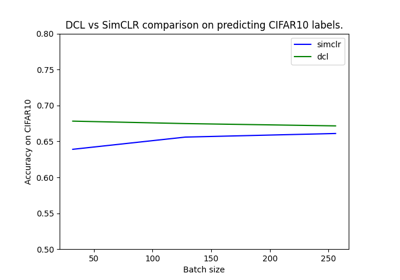
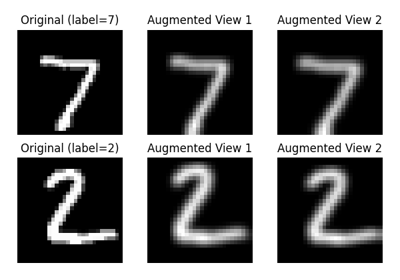
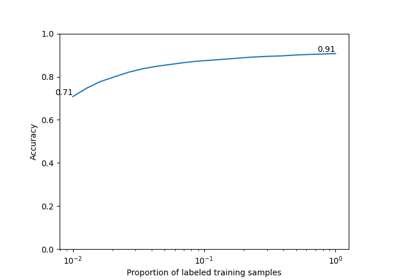
Self-Supervised Contrastive Learning with SimCLR on MNIST
Visualization of metrics during training of PyTorch-Lightning models